
Repower is pleased to announce a new partnership with the Korea Advanced Institute of Science and Technology (KAIST), focused on the role of coal power plant repowering in Korea’s energy transition and future global decarbonisation pathways.
Under a grant from Repower to KAIST, this engagement—spearheaded by KAIST professors Son Hwi Kim, alongside Haewon McJeon and Jeong Ik Lee—will explore coal power plant repowering using the Global Change Analysis Model (GCAM), an internationally recognised integrated assessment model (IAM) used to simulate long-term energy, emissions, and socio-economic pathways.
The core idea is to assess how coal power plant repowering could contribute to wider national and global energy transition pathways.
Modelling repowering beyond individual plant sites
The work will focus first on the Republic of Korea.
KAIST’s team will work to expand GCAM-KAIST so that it can represent individual coal-fired power units in Korea, rather than treating coal capacity only as a broad system-level number.
That matters because every coal plant is different. Each site has its own capacity, grid connection, lifetime, water and resource characteristics, emissions profile, employment links, and local economic role.
A more detailed model can help assess how different repowering pathways could affect emissions, energy supply, grid reliability, plant replacement timelines, climate policy costs, and local economic outcomes.
Weaning the world off coal
Coal power plants (CPPs) remain the single largest individual source of electricity worldwide, as well as the single largest source of energy-related CO₂ emissions.
Coal generated about 33% of global electricity in 2025—and while renewables collectively overtook coal for the first time in a century that year, no single renewable source (solar, wind, hydro, or bioenergy) individually matches coal (Ember 2026, Global Electricity Review 2026).
Coal also accounts for roughly 40% of global energy-related CO₂ emissions (IEA 2024, Coal 2024 – Analysis and forecast to 2027).
In Korea, coal generated about 30% of the country’s electricity in 2024 (Ember 2026, Countries and Regions, South Korea) and the country still operates ~39 GW of coal capacity—the seventh largest fleet in the world (Global Energy Monitor 2025, Boom and Bust Coal 2025). The power sector as a whole makes up roughly a third of Korea’s total greenhouse-gas emissions, with coal the dominant contributor (The Korea Herald 2025, “Korea’s emissions drop, but 2030 goal out of reach”).
Why Korea is a strong pilot case
Korea is a particularly important pilot country for this work.
The country has committed to a net-zero greenhouse gas emissions goal by 2050 and faces a specific set of energy system challenges: limited land availability, a highly energy-intensive economy, and growing electricity demand driven by electrification and new energy-intensive sectors such as AI data centres.
These factors make the reuse of existing coal power plant sites a strategically important option for clean power deployment.
Repower has already been building work around South Korea’s coal power transition. You can explore related Repower resources on South Korea and KAIST.
Where RepowerScore fits in
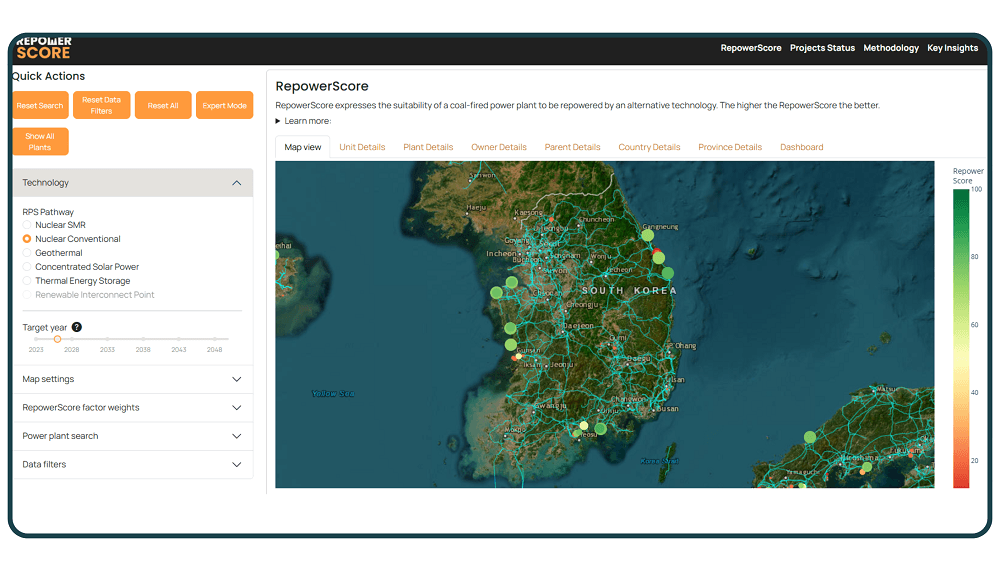
The research will also examine how RepowerScore can support scenario development by helping identify which coal plant sites may be most suitable for different repowering pathways.
This part of the work will integrate Repower efforts to test the impact on national and global energy transition pathways.
RepowerScore provides site-level insight into the suitability of coal units for clean energy repowering. GCAM-KAIST can then help explore what those site-level decisions could mean for national and global energy pathways.
RepowerScore has already been used to support Repower’s wider work on coal plant suitability, including recent work in China.
This will connect two things that are often studied separately: individual coal plant sites and long-term energy system planning.
Project milestones
The work will be structured around two main stages.
Milestone 1: Korea focus
The first stage will focus on Korea and is expected to include:
- an interim report on the value of repowering for carbon emissions mitigation in Korea;
- updates to GCAM-KAIST, including model calibration and discrete representation of power units;
- scenario generation, including baseline pathways, technology policies, repowering options, coal-to-nuclear, net-zero emissions, and long-term global temperature goals;
- an interim presentation and slides for progress updates, information sharing and feedback; and
- a technical report or potential peer-reviewed paper on the application of GCAM-KAIST to repowering in Korea.
This stage is intended to clarify and quantify the specific contribution of repowering within Korea’s broader energy and climate transition.
Milestone 2: beyond Korea
The second stage is expected to build on the Korea analysis and explore how the modelling approach could be expanded beyond the initial pilot.
This may include:
- additional sensitivity cases for repowering;
- deeper analysis of site suitability using RepowerScore;
- assessment of local impacts, depending on the availability of site-specific or plant-specific data;
- effect of repowering in China- or global-based scenarios on socio-economics and their effect on the worldwide climate, i.e., the effect of repowering on global temperature responses;
- final technical reporting and presentation materials for Repower, future Repower Summits and wider dissemination; and
- a technical report or potential peer-reviewed paper on GCAM-KAIST applications beyond Korea.
The long-term ambition is to move towards a modelling approach that can help assess the global impact of repowering existing coal power plant infrastructure.
From site-level decisions to national energy pathways
For Repower, this work helps answer a core question:
What happens when repowering is assessed not only plant-by-plant, but as part of national and global energy transition pathways?
Much of the work to date has focused on technical feasibility, site-level analysis, and regional case studies. This new engagement can help connect that work to wider questions around energy supply, emissions pathways, climate policy, and local economic impacts.
Repowering is about sustainable options to coal, not replacing everything around it.
By bringing together KAIST’s modelling expertise and Repower’s growing work on coal plant site suitability, this engagement can help show where existing coal infrastructure could make the clean energy transition easier, more practical, and less disruptive.