
Repowering a coal-fired power plant does not always mean replacing its boiler with a clean heat source. In China, one company is retrofitting coal plants with heat-pump molten-salt thermal energy storage: electricity is used to heat molten salt when power is cheap, and the stored heat runs the plant’s existing steam turbine when power is needed.
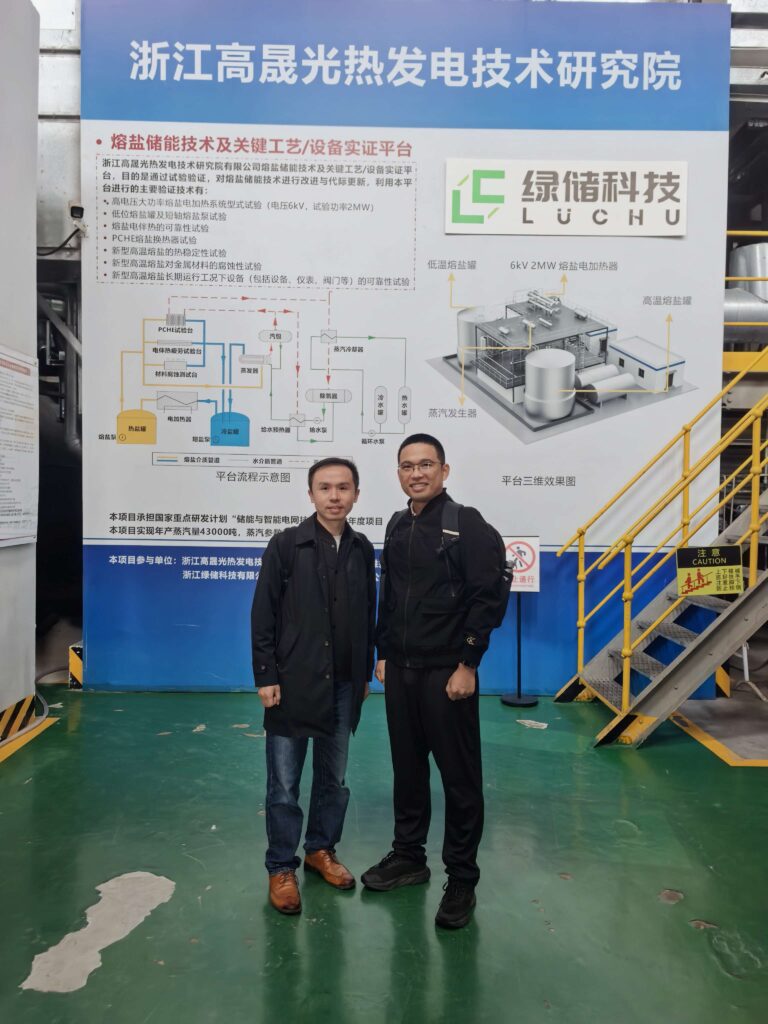
Dr Yaoli Zhang, Associate Professor at the College of Energy, Xiamen University, leads research on coal-to-nuclear repowering in China in collaboration with Repower through the C2N Open Knowledge Project. In this interview, he talks to Junfeng Wang, director of Lüchu Tech, about how the two pathways could work together and what stands between demonstration and deployment at scale.
Technical complementarity and site suitability
Yaoli Zhang: My research focuses on coal-to-nuclear repowering—specifically, replacing a coal plant’s boiler with a nuclear reactor while retaining the existing steam cycle system. Your company’s technology takes a completely different technical route by retrofitting plants with thermal energy storage systems. How do you view the complementary relationship between these two pathways? And which types of coal-fired power plants are better suited for thermal storage retrofits rather than nuclear replacement?
Junfeng Wang: Compared to heat-pump molten-salt thermal storage systems, nuclear replacement faces relatively more constraints:
- Steam parameter mismatch and technical complexity: Conventional coal plants generally operate at high temperatures using superheated steam, whereas mature pressurised water reactors (PWRs) generate electricity using saturated steam. Because there are significant differences in their steam cycle systems and core equipment, repurposing existing components presents major adaptability and technical challenges. Even if advanced high-temperature reactors—such as high-temperature gas-cooled reactors (HTGRs) or sodium-cooled fast reactors (SFRs)—are deployed, extensive technical modifications are still required for turbine steam parameter matching, regenerative heating systems, and cooling systems.
- Siting and safety restrictions: Most existing coal plants are located inland and lack strict buffer zones separating them from surrounding residential areas, meaning they often fail to meet the exclusion zone and safety boundary requirements mandated for nuclear power sites.
Overall, nuclear replacement imposes much stricter siting requirements on coal plants, so the number of eligible sites is likely quite limited. However, once siting issues are resolved and steam-water system upgrades are completed, nuclear replacement and heat-pump thermal storage are entirely complementary. Heat-pump thermal storage can assist nuclear systems in peak shaving and frequency regulation, generating additional revenue in ancillary service markets while compensating for nuclear power’s limited operational flexibility. Together, they can facilitate the integration of surrounding renewable energy, transforming nuclear power into a flexible, low-carbon baseload source that progressively replaces fossil fuels.
“Once siting issues are resolved and steam-water system upgrades are completed, nuclear replacement and heat-pump thermal storage are entirely complementary.”
Junfeng Wang, director, Lüchu Tech
De-risking investment and commercial feasibility
Yaoli Zhang: When power plant owners and other decision-makers visit your demonstration project on-site and see the technology in operation, what specific factor—whether a particular metric, an operational milestone, or something else—typically dispels their doubts and convinces them that this type of retrofit can be deployed at low cost and at scale?
Junfeng Wang: Achieving low-cost, large-scale deployment generally requires addressing concerns across two dimensions:
- Technical validation: Plant owners need clear evidence of how long the demonstration unit has operated stably and reliably under required conditions, proving the long-term durability and dependability of the system and equipment. At the same time, they need to see real-time operating parameters—such as current heat pump operating temperatures and coefficient of performance (COP)—to verify that the equipment meets its promised performance benchmarks.
- Investment economics: Owners need full transparency into the total capital expenditure (CAPEX) of the demonstration unit, including the exact cost breakdown across equipment, installation, and civil engineering, as well as the projected cost-reduction potential once the technology matures. This allows owners to run their own financial models and clearly calculate the return on investment.
Policy incentives and market economics
Yaoli Zhang: China’s Special Action Plan for the Large-Scale Construction of New Energy Storage (2025–2027) explicitly encourages coal-fired power plants to conduct deep peak shaving and grants priority dispatch rights to new energy storage. How significant is this policy environment in driving actual project implementation? And what hurdles still need to be overcome to translate top-level policies into plant-level investment decisions and physical, operational projects?
Junfeng Wang: Policy only serves as a directional guide; actual deployment must be driven by economics. Right now, the primary driver is the local installed capacity of renewables—particularly solar photovoltaics (PV). Only when solar penetration is high, causing electricity spot markets to remain at floor prices for extended periods during peak daytime generation, do power plants develop an intrinsic financial motivation to pursue deep peak shaving and energy storage in order to minimise losses and improve profitability.
Therefore, project execution depends first and foremost on local spot market operating data, such as peak-to-valley price spreads and duration. Second, it depends on the specific conditions and existing capabilities of individual plants—facilities with insufficient deep peak-shaving or peak-generation capacity have a much stronger willingness and economic incentive to retrofit. Finally, it comes down to concrete execution details, including financing arrangements, business models, and the local implementation of supporting policies.
“Policy only serves as a directional guide; actual deployment must be driven by economics.”
Junfeng Wang, director, Lüchu Tech
Engineering bottlenecks and the comparison with solar
Yaoli Zhang: Lüchu has already built megawatt-scale demonstration systems operating at several hundred degrees Celsius at pilot sites. To scale from demonstration projects to the thousands of retrofit-eligible coal units across China—and potentially to other coal-dependent nations in the future—what is the biggest engineering bottleneck? Furthermore, compared to solar PV technology, which has been successfully exported worldwide, what is the core difference with your technology?
Junfeng Wang: First, we must have a commercial-scale demonstration project operating domestically—construction on this has already begun, with commissioning scheduled for the end of 2027. The successful commissioning and sustained, compliant operation of this commercial demonstration project is a prerequisite for large-scale rollout. Second, regional wind and solar resource profiles, spot market dynamics, and policy variations all heavily influence scalability, often serving as the direct determinants of whether a project is economically viable.
Regarding the core difference with solar PV: PV technology is a completely standardised product. It places relatively low demands on the overall engineering capabilities of the vendor, making it easy to promote with a low barrier to entry. In contrast, a heat-pump molten-salt thermal storage system is not a highly standardised technology. Only certain sub-components can be standardised; the overall system generally requires customised engineering tailored to site-specific conditions. This demands exceptionally strong technical and engineering capabilities from the executing company, resulting in higher deployment requirements and a much higher barrier to entry.
“Only certain sub-components can be standardised; the overall system generally requires customised engineering tailored to site-specific conditions.”
Junfeng Wang, director, Lüchu Tech
Global replicability and lessons from China
Yaoli Zhang: Looking toward an international audience—specifically overseas utilities, policymakers, and engineers closely tracking power plant retrofitting pathways—what lessons from China’s broader energy transition (across technical, regulatory, or financial dimensions) offer the greatest reference value for global replication? Conversely, what conditions are unique to China?
Junfeng Wang: While we have not specifically studied overseas coal plant retrofits, the global shift toward wind and solar will inevitably create a shortage of flexible grid resources. As non-dispatchable renewables grow, power markets will experience frequent price floor and price spike events, driving demand for long-duration (6+ hours) energy storage. Heat-pump molten-salt storage is well-suited for this need because it offers low costs, large capacity, long duration, and high reliability.
Because these systems are both technology- and capital-intensive, scaling them requires strong public or private funding during research and development (R&D), followed by a complete supply chain to ensure quality and lower costs during commercialisation. Both China and developed nations can support these phases, though China holds a distinct advantage in end-to-end supply chain completeness.
On the regulatory side, however, China’s electricity spot markets remain relatively conservative, using strict price caps and floors that limit storage revenues. In contrast, the more mature, liberalised spot markets in developed countries are much better structured to maximise the financial returns of this type of thermal storage.
Key takeaways
- Different pathways suit different sites. Nuclear siting and safety rules may exclude many inland coal plants, while thermal storage can fit more widely—and the two can work together where both are possible.
- Markets, not policy, make the business case. Retrofits follow high solar penetration and long periods of floor prices in spot markets; operating data and transparent costs are what convince plant owners.
- Scaling depends on a commercial demonstration. Lüchu’s commercial-scale project is due to be commissioned at the end of 2027, and each system needs engineering tailored to its site.
Thermal energy storage is one of several repowering pathways, alongside advanced nuclear, next-generation geothermal, concentrated solar power, and renewable interconnection. Which one fits depends on each site’s location, equipment, grid, and local power market—so site-by-site assessment matters. RepowerScore ranks coal-fired units by their suitability for different pathways as a first step in that assessment.
The views expressed are those of the interviewee. This interview has been edited for length and clarity.
Related reading:
- Three new peer-reviewed papers strengthen the evidence base for coal-to-nuclear in China
- Repower Initiative to collaborate on major new coal-to-nuclear project in China
- Explore coal-fired units by repowering pathway on RepowerScore
- Special Action Plan for the Large-Scale Construction of New Energy Storage (2025–2027), NDRC and NEA, 27 August 2025 (in Chinese)