
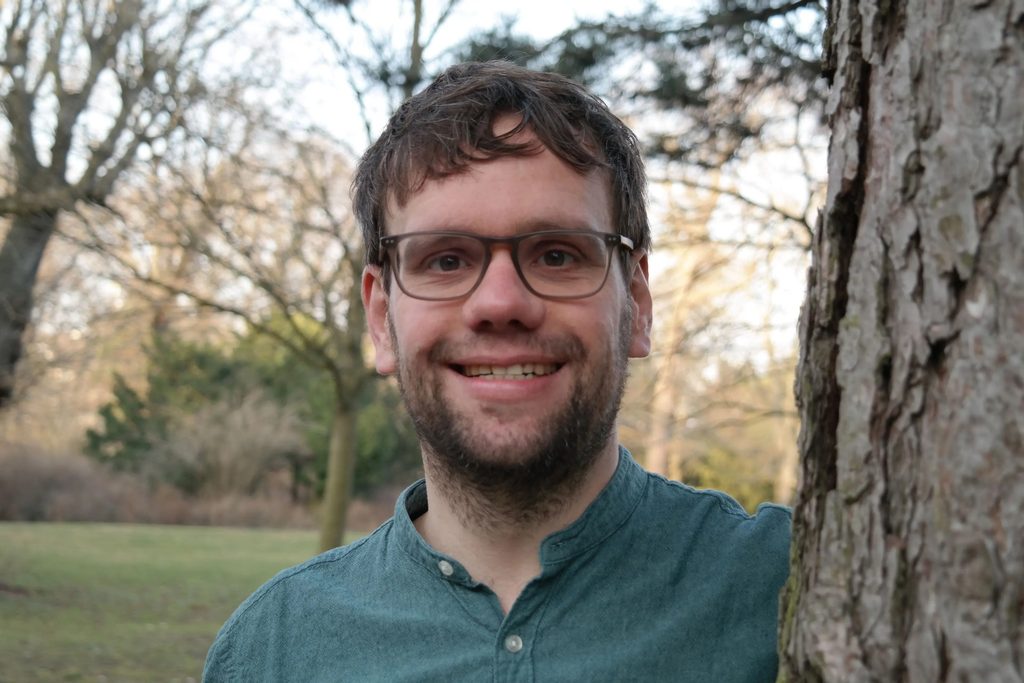
Since 2022, Founders Pledge has helped the Repower Initiative build the evidence base for coal-to-clean transformations around the world. In this interview, Founders Pledge climate lead Johannes Ackva walks us through his journey into becoming a repowering advocate, the hunger for technological innovation in China, and what it means to make an impact through philanthropy in overlooked parts of the climate battle.
What pulled you into the repowering community to begin with?
Our starting point at Founders Pledge is that most climate philanthropy clusters around a fairly narrow set of fashionable solutions, largely the deployment of mature technologies in wealthy countries, and that this leaves many areas underfunded relative to how much they might matter. The Founders Pledge Climate Fund specifically supports solutions that are off the radar for most funders, but that we think could radically impact the trajectory of future global emissions.
Our grantmaking on repowering began in 2022, with grants to TerraPraxis, Quantified Carbon (the organisation that originated the Repower Initiative, then “Qvist Consulting”), and Tsinghua University.
What drew us to this idea was the fact that repowering is one of the few levers that could plausibly tackle the largest source of committed emissions. Relatively new coal plants in emerging Asia are, on their own, sufficient to jeopardise any ambitious climate targets if they run for their full natural lifetimes. China alone has ~1,271 GW of operating coal power capacity, over half of the world’s total. Because retiring coal plants early means significant economic losses, this can lead to “carbon lock-in”, where existing infrastructure commits us to emissions for decades to come.
Repowering coal plants by retrofitting them with alternative low-carbon heat sources, like advanced nuclear, offers an innovative solution to that problem. This solution was and still is incredibly neglected, with almost no other climate funders willing to invest. My sense then was, and still is, that this neglect is mostly for bad reasons. Much of climate philanthropy bets on, and fights for, a world where renewables completely replace coal plants, even very young ones. An approach that repowers coal is not likely to be attractive to those funders, especially one that works through technologies that are speculative and, in climate funder circles, broadly unpopular, such as small modular reactors (SMRs).
This combination of “big if true” and also “overlooked for the wrong reasons” is the sweet spot we are looking for, and it is what led us to invest, knowing that even a small probability of success would justify taking the bet.
“Repowering coal plants by retrofitting them with alternative low-carbon heat sources, like advanced nuclear, offers an innovative solution to the problem [of carbon lock-in].”
Do you ever hear fears that repowering can become its own kind of lock-in, preserving old grid topology, utility structures, or workforce patterns in ways that make more transformative options harder down the line?
To me, this reflects a common mistake we see in climate discourse, which is to privilege transformative solutions as though there is something inherently desirable about transformation. I think this mostly comes out of how much the climate and energy conversation is dominated by the green movement and its allies, who treat societal and technical transformation as inherently desirable, and see the energy transition as a part of this.
So, in some sense, my response to these fears would be: even if repowering made transformative solutions less likely, why would this matter? What we care about is how much carbon we keep out of the atmosphere, and how quickly and cheaply we do it. If repowering delivers that by reusing existing infrastructure, in a way that’s faster and less disruptive than starting from scratch, we shouldn’t wait for the idealised possibility of a fully transformed grid.
In another sense, though, I think you are pointing at the risk of partial decarbonisation or repowering being used as a smokescreen. That would obviously be bad.
What I am interested in, principally, is not to maximise repowering, but to maximise decarbonisation progress. So the goal of our work on repowering is to increase the salience of the idea, to have it be taken seriously and properly explored, and then pursued if it wins out against all of the other solutions that might be feasible.
Where would your own framework say repowering is, perhaps, the wrong call?
I can imagine two answers to this question.
One is really, “when is repowering the wrong bet?” and another is “when is it the right bet, but unable to flourish?”
I think the difference is crucial.
Part of repowering’s appeal is that it is a hedge against worlds with a lot of climate damage: worlds where new coal plants don’t get retired, where transmission or seasonal storage remain vexing problems, or where other obstacles limit the uptake of renewables and other mature technologies.
Maybe those worlds never materialise. But that doesn’t make repowering a bad bet, in the same way that using a seat belt is not a bad behaviour even if you never get into a crash.
Repowering, just like wearing seat belts, is part of a prudent portfolio, in that state of affairs. I think this is the state of affairs we are in.
Another state of affairs that we could be in is that “repowering” would be a bad idea to begin with, that it is obvious that it won’t be needed and that it is just a distraction. I think some proponents of 100% renewables believe this, but it strikes me as very unlikely to be true.
Fundamentally, as discussed above, repowering is one of the very few strategies that has a shot of working if plausible but bad conditions are true—namely that it remains hard to retire coal plants that are quite new. This is arguably the biggest stream of committed emissions, so strategies addressing this have a disproportionately good shot of being good bets.
“Repowering, just like wearing seat belts, is part of a prudent portfolio.”
You’ve spoken about a Founders Pledge-funded coal-repowering project in China exploring both nuclear and advanced geothermal heat sources, and you’ve flagged that the next post in your 2026 grants series will turn to your China work. Could you talk us through how you think about having an impact in China?
I met with the Repower team in China in April, and I think we all saw how real the momentum there is, and how much there is a hunger to drive technological innovation in general.
Once China decides it is interested in pursuing a given technological path, I do think the contribution of philanthropy mostly ends.
But the fact that we had the chance to attend the Repowering Conference in Beijing was a direct result of philanthropy (not ours!). The original paper that got repowering in its current incarnation started, by your founder Staffan Qvist, was the direct result of a grant given by your other founder, Baroness Bryony Worthington. This paper then sparked interest and created waves in China and drew in Tsinghua University, whom we then funded in 2022 to expand this work and pursue it in earnest. Today there is a substantial body of research and, maybe more importantly, a lot of young and hungry talent that is bringing this idea into Chinese academia, industry, and policymaking.
This wouldn’t have happened without philanthropy, and it is totally compatible with the constraints in China. And, indeed, I would say this is a rather typical example of effective philanthropy: creating opportunities that are win-win once initial philanthropic work has been done, and making use of the fact that societal resources are magnitudes larger than philanthropic ones.
How do you see the philanthropic nuclear funding landscape shifting? With the Global Coalition for Nuclear Philanthropy now bringing in major funders like Rockefeller and Temasek Trust, does more capital in the space change what Founders Pledge sees as the most neglected, highest-leverage bets? Do you think any of the potentially massive surge of philanthropic funding coming out of the artificial intelligence (AI) gold rush will play a role here?
We are a founding member of the Global Coalition for Nuclear Philanthropy, and we really hope that this coalition will realise our plea to at least triple pro-nuclear philanthropy. We are delighted that the coalition has succeeded in getting large institutional philanthropies excited about nuclear.
Frankly, I hope for a world where players like Founders Pledge do not need to engage in nuclear philanthropy anymore, because all of the big foundations are in the game and treat it as a normal part of their climate and clean energy work.
If and when this happens, it will surely affect our prioritisation in the way you describe. Indeed, quickly changing funding patterns are one of the main reasons why we do not have an evergreen list of recommendations but rather offer a fund-based model for anyone who wishes to make a climate change donation.
That said, institutional philanthropy moves slowly, and most of the AI gold rush will be delayed and slow to start. So, right now is still a great time to invest in the pro-nuclear ecosystem and, indeed, it can be crucial bridging work to grow organisations and fields for when the AI gold rush arrives.
One pattern I’ve seen several times is what I call “philanthropic chicken”: everyone expects others to jump in, and then no one actually funds the thing. Right now, I am worried about that impression—the imminent gold rush—more than the actual gold rush. At the same time, as you allude to, in my ideal world, this work will be as mainstream as rainforest philanthropy in ten years.
“In my ideal world, this work will be as mainstream as rainforest philanthropy in ten years.”
Founders Pledge’s grantmaking approach emphasises modelling structural, multi-year trends rather than reacting to any single year’s headlines. Given how mercurial political coalitions and fragile political consensuses in climate have been in the past few years—with China as a potential major exception—what do you see as the biggest risks to long-term planning in climate philanthropy?
Great question, this is something we think about a lot. All philanthropy is dependent on the societal conditions around it, and much of climate philanthropy in particular depends on strong climate policy.
This is one of the reasons to spread your philanthropy across jurisdictions, to build resilience against political changes.
It is also a reason to pursue robust strategies, focusing on solutions and approaches that are not dependent on strong climate momentum persisting for decades.
What worries me most right now is that the climate backlash we have seen in many parts of the West, in the US but also, less remarked upon, in Europe, becomes so severe that it undercuts the investment and confidence in the current frontier of decarbonisation.
I am not worried about whether we will continue to have cheap solar and electric cars, as these solutions are mature and here and they do not need much climate momentum to keep going. What is far less certain is whether we get green steel, decarbonised cement, repowering, and sustainable aviation. These are the solutions that still require an additional push, and I am worried that, while an energy crisis and surging electricity demand are more potent than climate policy ever was, they will leave precisely these drivers neglected—the ones that most depend on explicit climate policy support, one reason we are strongly engaged in defending European climate policy architecture.
About Johannes
Johannes joined the Founders Pledge research team in autumn 2019 and has been leading its climate work since 2020, building the Founders Pledge Climate Fund and the climate research team. His research and grantmaking have been covered by the Wall Street Journal, the New York Times, Vox, Volts, Prospect Magazine, Giving What We Can, 80,000 Hours, and the Future of Life Institute, amongst others.
He brings five years of experience working in a think tank advising decision makers on climate policy and has also researched the intersection between effective and feasible climate policies. Johannes holds an M.A. in Social Sciences from the University of Chicago and an M.Sc. in Sociology, with a focus on research methods, from the Interuniversity Centre for Social Science Theory and Methodology at the University of Groningen.