
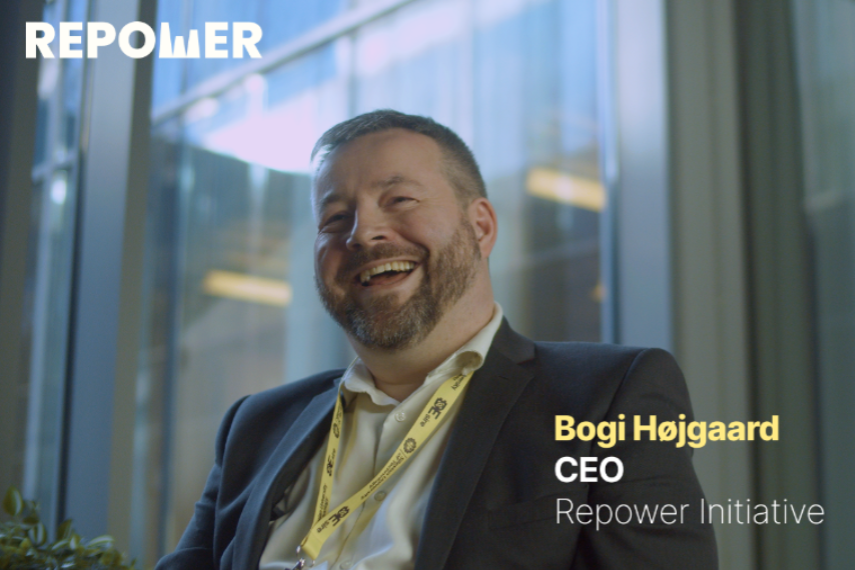
Bogi Højgaard is the CEO and board member of Repower Initiative.
We caught up with Bogi last year at the summit in Poland, where he shared his views on repowering, including the vital grid stabilisation aspect it provides for systems heavily based on variable renewables.
Tell us about your previous role before Repower Initiative?
In my previous role as Associate Director at the CATA Carbon Trust, we worked on several pieces of work on coal retirement across Southeast Asia and particularly in South Asia. When we started, we were tasked with retiring coal plants. We would go into a country and discuss with the energy ministry and the stakeholders there and offer them help in closing their coal plants. That went down very badly. Offering to reduce energy production doesn’t align with what a lot of these countries need, which is more energy, and this creates concerns. After trying that a couple of times and maybe not being as successful as we had hoped, we repackaged that and came up with a different way of looking at it.
The approach there was to say, you need to look at the challenge in a systemic way, where you start by saying what kind of system would allow easy retirement of coal? The coal retirement is an output; it’s not an input to the process. You start by saying, what would you replace it with? What market conditions or market setup would you need? What regulations? You start with that. Once you’ve got that in, then you can start talking about the retirement or repowering. It’s starting with the end in mind.
What is a great success story in the clean energy transition?
There’s a great success story in terms of how cost effective, how cheap renewables have become. There are challenges with that and how to manage that. How do you raise the financing for that? The fundamental cost of particularly solar, offshore wind, and storage have really come down a lot. The trend is very much towards decarbonisation. So I think that’s good.
I think the problems with that is that if you’re using fossil fuels, it’s often cheaper to start with something like a gas plant that is cheap to build, but that becomes more expensive to run because you don’t have the upfront capital. I t the biggest challenge is mobilising the investment so you can invest in the things that get you a cheaper longer-term cost.
Can you explain repowering specifically?
The fundamental principle is that you want to reuse the infrastructure that we’ve already spent a hundred years building. You’ve built all these cables, these steam turbines, these cooling towers, so why not reuse it? I think that is an excellent principle to start with, because the biggest challenge with the energy transition is the cost: managing the cost for consumers and reducing the cost of living for consumers.
In repowering, you can take a coal plant—essentially the coal plant is there to provide heat—to make electricity. You can replace that source of heat with something else. That could be biomass, that could be nuclear, that could be geothermal. There are various ways of replacing that heat source, but that’s the principle of it.
Is repowering possible everywhere?
Some places are better placed than others. In some countries, for nuclear development, the capability of a country and their experience of managing nuclear programs will mean that some countries will be able to do this quite easily and some countries will not. In principle, it should work in several countries, and the more the technology advances, in terms of, for example, advanced geothermal, the more areas should open up for repowering.
What are the challenges with repowering?
There are some solutions that might look attractive on the surface that can distract from the longer-term optimal solution (if there is such a thing). One concept that’s been proposed is replacing coal with ammonia. In principle, that works fine: ammonia doesn’t emit any carbon. But for that to make sense, it would need to be green ammonia derived from renewables. That ammonia then has an alternative user case in, for example, fertiliser production. If you can replace green fertiliser production, the grey ammonia there, with green ammonia, you could save carbon. It becomes a competitor to food directly. Even if it makes sense on an individual scale, it probably doesn’t scale as well as other solutions such as nuclear.
Biomass is also complicated because it can lead to environment and habitat destruction if not managed properly. Different ways of repowering will have different ways of scaling and different end uses. I would also say that repowering is part of a mix. I think a large part of the deliverable also would have to be renewable energy in general; solar and particularly offshore wind is what we’ve used a lot in the UK. Nuclear is also highly expensive, so it will be important to get it cheaper than zero carbon.

How does Repowering accelerate us towards a decarbonised world?
The challenge is to bring people along with you and get them to buy into the long-term vision. One of the concerns that people raise repeatedly, which is a justified concern, is how do you manage a system that is heavily based on variable electricity? That could be the changes in wind and solar output, but it’s also the stability of the grid, in terms of inertia and reactive power provision.
What repowering could do very well in that section is to provide some of that anchor capacity, some of that inertia and reactive power. Although you can also get that from some renewables, if you build them correctly, I think Repower has that grid stabilisation element.
The point is it’s a combination of things. It’s a mix. It’s not one size fits all. Repower has a very strong role to play in grid stabilisation with low carbon.
Positive Statement in Faroese about Repowering
Repower er særartrydningar mitt fyrir at stegja bakstørhållsarinnan og at mynka om CO2-utlater, og kan arbeide yllirværldssam vid halvvende, sæl og atomkraft, så vi må bruka mål i det her tøy.
Repowering is in the midst of efforts to increase energy security and reduce CO2 emissions, and can work interchangeably with renewables, solar, and nuclear power, so in this respect, we must use it.
Read the press release of Bogi’s appointment